
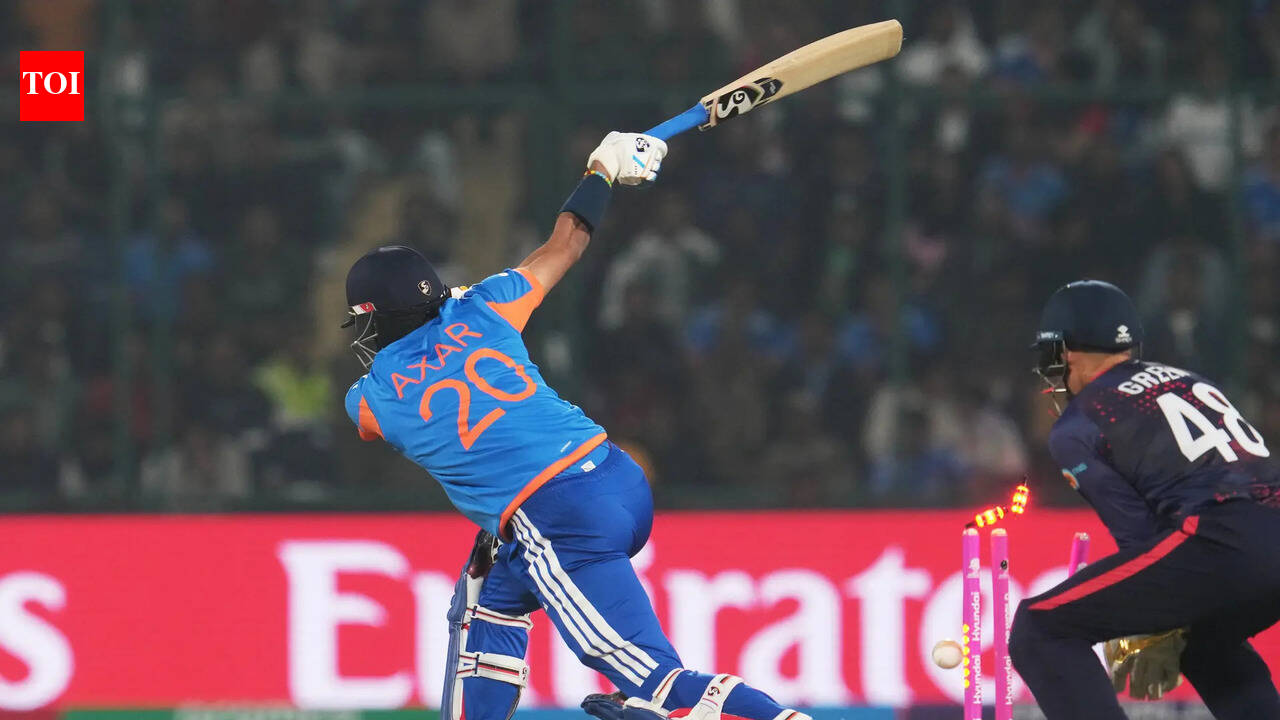

New Delhi: 45/1 to 77/6 against the USA. 205/4 to 209/9 against Namibia.India won their first two T20 World Cup contests rather convincingly but two batting collapses, occurring at different junctures of the game, should serve as a wake-up call for the batters ahead of the game against Pakistan on February 15 in Colombo.
In both matches, the word from the Indian camp remained constant. They expected the wicket to be flatter and behave a certain way but the sluggishness in Mumbai and the odd low bounce in Delhi caught them off guard. Colombo is expected to be no different and will require a lot of adaptation and unlearning for a destructive batting unit which has feasted on batting paradises in the bilateral fixtures which preceded the multi-nation tournament.The sample size isn’t that big but both Shadley van Schalkwyk and Gerhard Erasmus have provided a blueprint to the remaining teams. If you must stop this marauding Indian unit, be tactically smart: mix up your approach and have different plans ready. This Indian XI boasts of as many as five, even six when Abhishek Sharma played the first game, left-handers in the top-eight but they are all different. What works for Ishan Kishan may not work for Abhishek and a similar plan will not get the job done for the likes of Tilak Varma, Shivam Dube, Rinku Singh and Axar Patel. From their approach to hitting arcs to technicalities, there is very little similarity, which makes it all the more important to have clear and precise plans for each one.

Shadley van Schalkwyk celebrates a wicket during the ICC Men’s T20 World Cup match between India and USA at the Wankhede Stadium. (Getty Images)
Schalkwyk mixed up his bumpers based on advice from his USA teammates and Erasmus was very smart in using angles, different release points and the crease. The delivery which got Tilak Varma took forever to reach the India batter because the bowler released it from far behind the crease. Even the step-out didn’t achieve the desired connection. Namibia coach Craig Williams praised his skipper, lauding his ability to deliver the toughest overs of an innings.“He trains incredibly hard at all these variations, and I think – he plays cricket around the world in some leagues and bowls all the difficult overs, he bowls some really tough overs. And, he’s continuously working on his game and trying to see how he can be more effective against batters. And I think tonight, again, against a world-class cricket team, he showed the world again what he’s got and his execution was just really good tonight. “I think his first three overs went for 16 or something and then to bowl that 19th over as all under pressure – first ball going for six and then pulling it back, I think it was just really fantastic so I’m really happy for him he trains hard and he works hard at these variations in his game,” said Williams at the post-match press conference.

Namibia’s Gerhard Erasmus troubled India’s batting in the T20 World Cup. (Agencies)
Erasmus certainly came prepared. While the occasional sling in the action can disrupt a batter’s concentration, Ishan felt it only takes a couple of balls to get used to it and clear it from one’s mind. Does it affect the plans to go big? Not really!“It might play in your head for a couple of balls, but I think at this level you need to have trust on your own strength as well. Even if he is trying to do something, we can go for sixes or boundaries at the same time. So important thing is how we are thinking at that point of time when the bowler is trying to do something different. But if we are just looking for boundaries and sixes and we are believing in our own strength I think that helps the batters more so we are just doing trying to keep it simple yeah some batters might score on, some batters won’t but it’s part of game and you keep on learning game by game,” said Kishan.India were set for another big total vs Namibia but ran out of steam in the last two overs, losing five wickets and added just four runs off the ten deliveries they faced. The set pair of Hardik Pandya and Shivam Dube departed off consecutive balls, Axar Patel didn’t score, and the ending starkly contrasted the explosive start Ishan and Sanju Samson provided. Ishan echoed the team’s sentiment on the pitch but felt the unit fared well with the bat and appreciated the opposition for executing their plans under pressure. The wicketkeeper-batter expects his side to take learnings from this fixture into the remaining games of the tournament.

Ishan Kishan smashed a 24-ball 61 against Namibia in the T20 World Cup. (Pic credit: BCCI)
“I think they batted pretty well. In both the wickets, I feel it was a bit different from what we expected to happen. And today, looking at the death overs, when we were not able to regularly hit big sixes, I think we need to also give credit to Namibia bowlers because they were bang on with their yorkers, they were bang on with their slow ones. “So yeah it was a good learning maybe if some other team is doing the same thing maybe we can use the crease more or we can do something different which can irritate the bowler. So it was a good learning in this game and especially I think It was not about our batters not able to hit sixes, but it was more of them bowling very well in the death overs,” explained Ishan.The USA had India on the mat, Namibia had their moments and an immediate course correction with the bat is needed to cover all bases against a spin-heavy Pakistan, who have already experienced the Colombo strip. The Suryakumar Yadav-led unit has bludgeoned attacks in the build-up to the World Cup but what worked yesterday may not work today and tomorrow is always a dive into the unknown. The muscle memory of tonking bowlers on flat pitches will need a quick unlearn as Colombo, and remainder of the tournament, may not follow the script everyone is so used to seeing played on loop.India’s remaining opponents would surely have noted the cracks that both the USA and Namibia exposed.









Leave a Reply